
Lumi at lumi8.dev
The AI illustrated-stories tool. Free, $9, $19, and $39 plans. Talk to it like a friend, get a finished story with pictures, narration, and a built-in reader. This is the Lumi we compare to below.
You are in the right place.
 NeolemonvsLumi
Lumi spins up a whole illustrated story in about ten minutes. Neolemon is the slower, more deliberate tool for the part that breaks a real book: keeping the same cartoon hero on-model across every single page.
20 free credits. No card required.
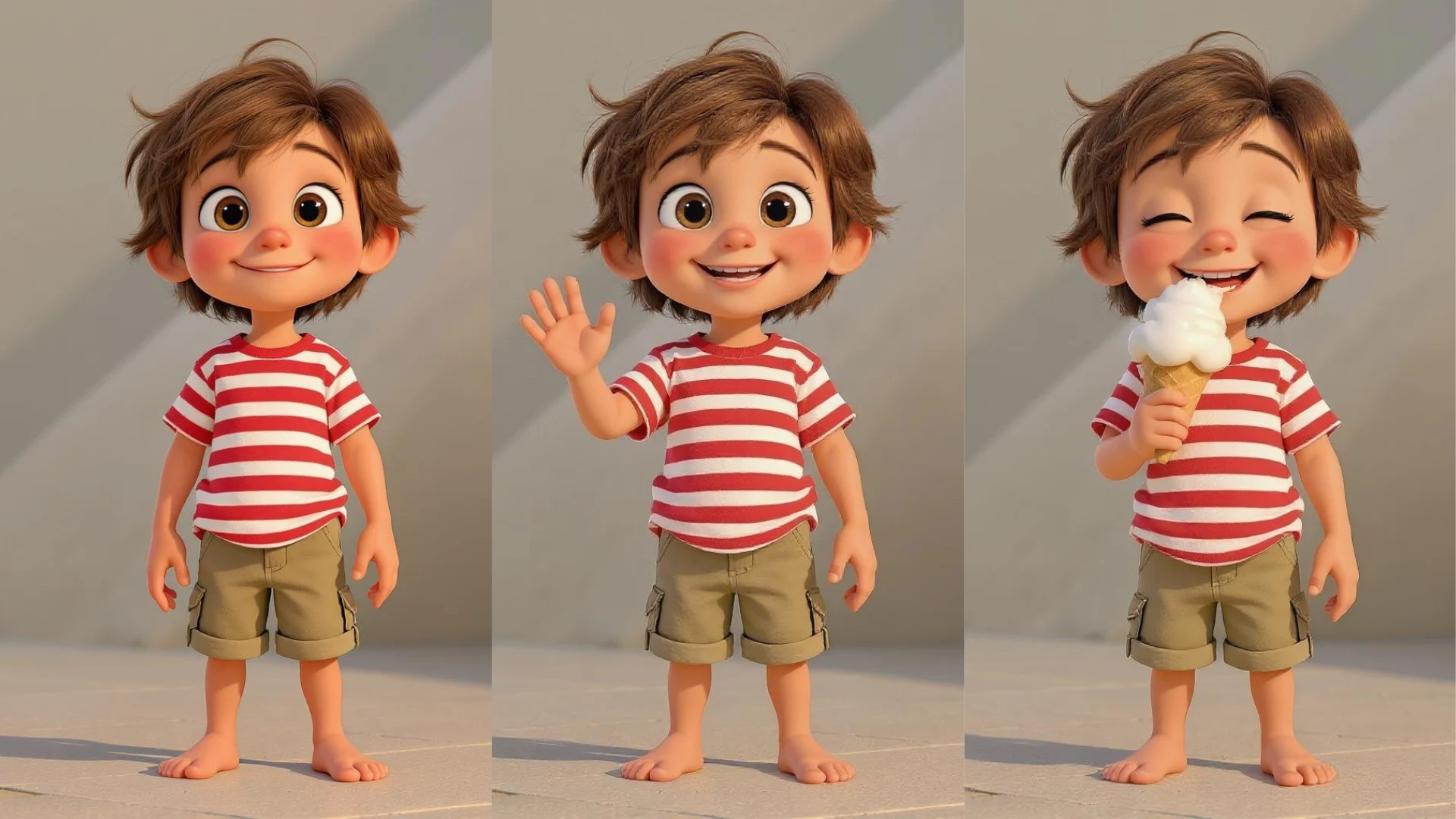
One character. Three poses. Zero drift.
First, the name
"Lumi" is a crowded brand, so a quick fork before anything else. This page compares Neolemon to the creator tool. If you wanted the school platform, we will point you there honestly and you can stop reading.
The AI illustrated-stories tool. Free, $9, $19, and $39 plans. Talk to it like a friend, get a finished story with pictures, narration, and a built-in reader. This is the Lumi we compare to below.
You are in the right place.
A K-12 literacy platform sold to school districts on tailored, quote-based pricing. Different product, different buyer. If you are a superintendent or curriculum lead shopping for a classroom tool, that one is likely your answer, not us.
Not what this page compares.
The whole comparison in one line
Lumi is the better tool for "I want a personalized illustrated story tonight." Neolemon is the better tool for "I am publishing a book and the character has to stay the same across every page." Almost everything below follows from that one split.
"Same character, different face every page. We focus on locking character appearance using a reference image system."
What you are comparing
Most "Lumi alternative" pages are sloppy here. Here is precisely what each one is, as of 2026.
A finished story, end to end
You describe an idea in plain language and Lumi does the rest: a story bible, character portraits, the chapters, an illustration per scene, page layout, and a built-in reader with page-flip animations and theme modes.
Worth knowing: Lumi prices by the story, not by the illustration. That abstraction is great for a casual user and foggy for a creator trying to estimate how many usable scenes a month actually buys.
A character workshop
Formerly ConsistentCharacter.ai. You build one anchor character, then direct it scene by scene. The book is what you make with the character, and it stays the same character the whole way through.
How consistency actually holds
Both tools can make a good first image. The danger in a 32-page book is the page that is almost right, where the eyes shifted, the outfit drifted, or a hand is doing something AI hands do. What you do next is the whole difference between the two tools.
Lumi: regenerateLumi's repair model is to roll again. You ask for another shot and hope the next version of the page is closer. Sometimes it is. Often you spend credits chasing the one detail that drifted, and you cannot touch only that detail.
Rolling the dice on a whole new generation. For a one-off bedtime story, fine. For a 32-page book, that is how a project stalls in month three.
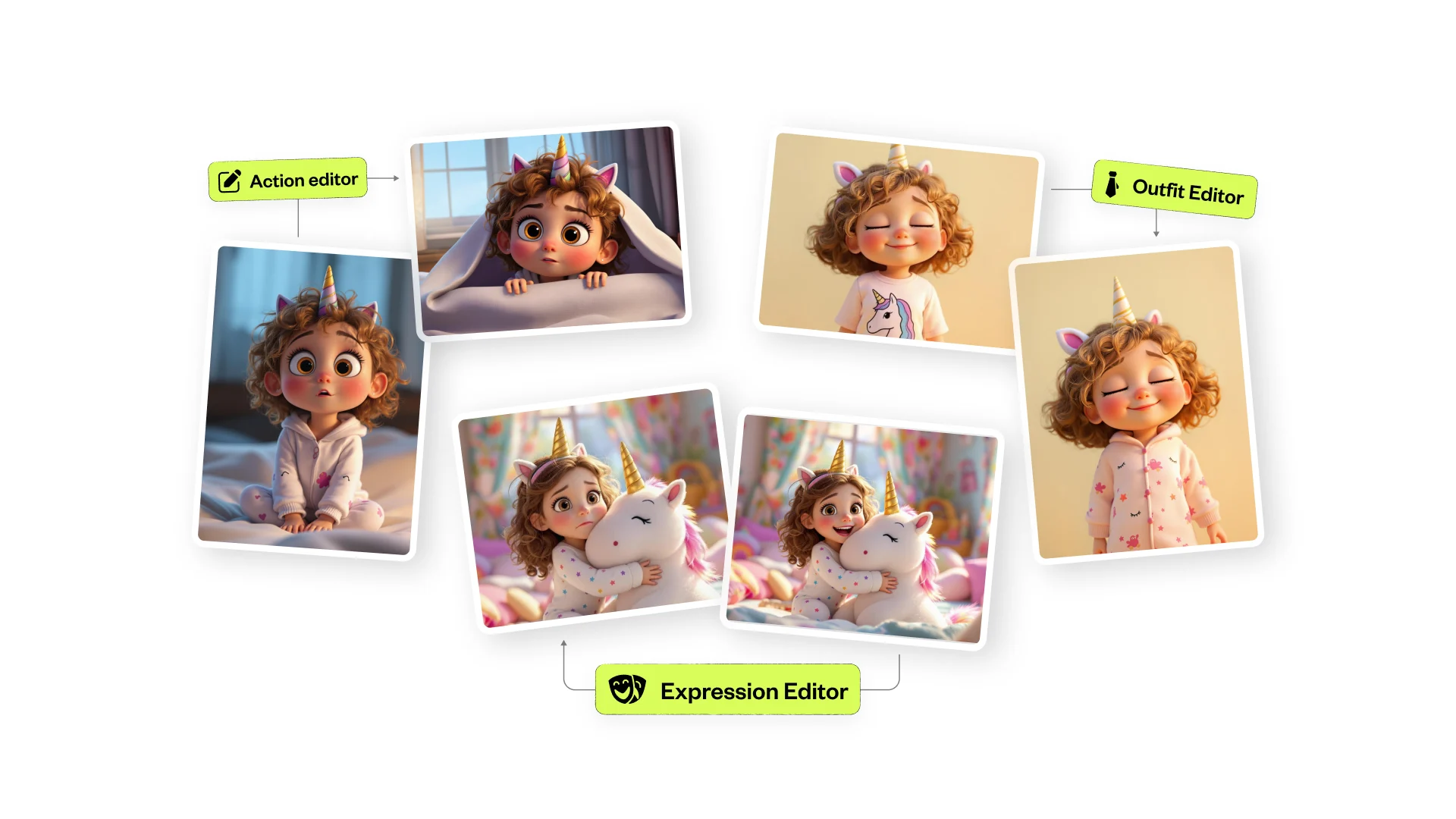
Neolemon: repairNeolemon's repair model is a targeted editor for whatever broke. Each editor is a constrained pipeline that changes only the one thing you asked it to and leaves the identity you signed off on alone.
Pose wrong?
Action Editor
Face too happy?
Expression Editor
Outfit drifted?
Outfit Editor
Wrong angle?
Perspective Editor
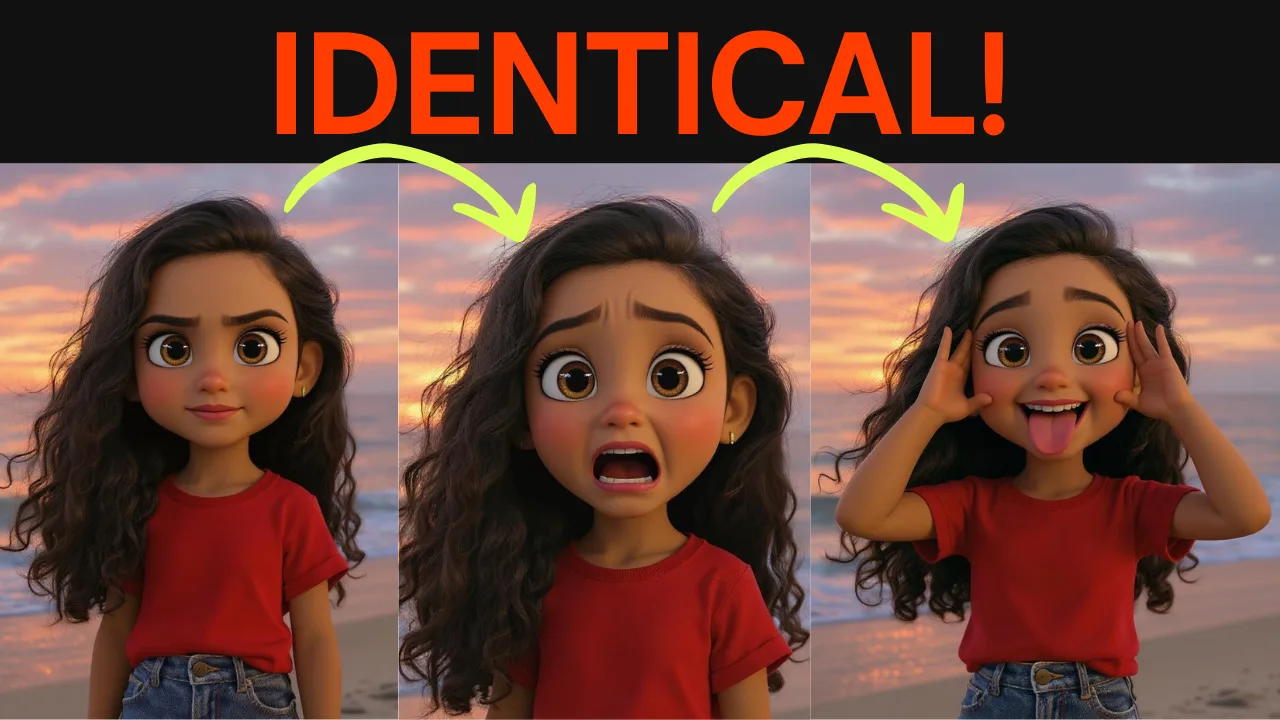
Every scene in Neolemon derives from one anchor reference, and every editor conditions on that anchor. So when page 23 needs a tweak, you change a single variable, not the whole image. The face stays the face.
The same approach powers the developer model on Segmind: a character reference plus an optional pose reference. It is a workflow for controlling consistency, not a wish for it.
The money question nobody frames right
The honest pricing question is not "which is cheaper." Lumi is cheaper if you count stories. It is "which currency matches your job." Here is the same dollar, measured two ways.
Lumi, priced by the story
~$0.38
per story on the $19 plan, by Lumi's own math, around 80 to 83 credits a story. Genuinely generous for casual, quick illustrated stories.
Lumi, the hidden part
?
credits per character preview, regeneration, edit, longer chapter, or failed generation. Lumi does not itemize what burns inside a story, so a serious creator cannot do the math up front.
Neolemon, priced by the image
4
credits per Character Turbo image, every time. 600 credits is about 150 controllable generations a month. You can do the math in your head before you sign up.
For one bedtime story a week, Lumi's per-story price is the right economy and we will say so. For a 24 to 32-page book where your hero is on every spread, you are buying controllable scenes, and that is the math Neolemon makes legible.
Feature by feature
Grouped by what you are actually deciding on. Where Lumi is the stronger pick, it says so plainly.
| Capability | Lumi |
Neolemon |
|---|---|---|
| Character control | ||
| Consistency across pages | Reference-image locking, story level | The core product: anchor plus editors |
| Pose and action | Driven by the story it writes | Dedicated Action Editor |
| Expression | Implicit | Expression Editor: eyes, brows, mouth |
| Outfit and camera angle | Implicit | Outfit and Perspective Editors |
| Fix one detail in place | Regenerate the image | Targeted editor, one variable |
| Multi-character scenes | Story-driven | Multi Character and Story Scene Pro |
| Reusable across a series | Story or session bound | Anchor image you reuse anywhere |
| Story and reading experience | ||
| AI writes the story | Yes, full text and chapters | No, you bring your own |
| Photo to main character | Yes, your face, any style | Yes, Photo to Cartoon |
| AI narration | Yes, multi-voice in-app | No |
| Built-in reader | Yes, page-flip and theme modes | No, you export the assets |
| Layout and canvas | In-app reader layout | Native AI Canvas with text overlays |
| Coloring-book pages | Not a stated use case | Coloring Book Creator, one click |
| Pricing, publishing, rights | ||
| Free way to try | 300 credits, ~3 to 4 stories | 20 credits, no card |
| Cheapest paid plan | $9 a month, 1,500 credits | $29 a month, 600 credits |
| Credit transparency | Per-story estimate, per-action unclear | 4 credits per image, stated |
| KDP-print export | Not on its public site | Storyboard PDF, not a print interior |
| Commercial-use rights | Founder says users own outputs | Included on paid plans |
| Developer API | None offered | Segmind V3 model |
Pricing and capabilities as listed on Lumi's public pages at lumi8.dev. Check their site before you buy. Neither tool is a one-click "publish to KDP" button, and we will not pretend otherwise below.
Pricing
No handwaving. Lumi's public plans on the left, our single plan on the right, with the fine print that actually matters for a creator.
| Plan | Price | Credits | Stated |
|---|---|---|---|
| Free | $0 | 300 | ~3 to 4 stories |
| Starter | $9/mo | 1,500 | ~18 stories |
| Standard | $19/mo | 4,000 | ~50 stories |
| Pro | $39/mo | 8,000 | ~100 stories |
$29 / month, flat
600 credits, about 150 generations. Plus a free trial: 20 credits, no card.
Neolemon costs more per month than Lumi's Starter, and that is not a bug. Lumi sells around 18 bundled story experiences. We sell 150 controllable generations with targeted editors. Do not compare sticker prices, compare how many usable final scenes you have after the revisions.
Proof, with names
Most comparison pages invent testimonials. Everything here is a real, named person with a public source, on both sides.
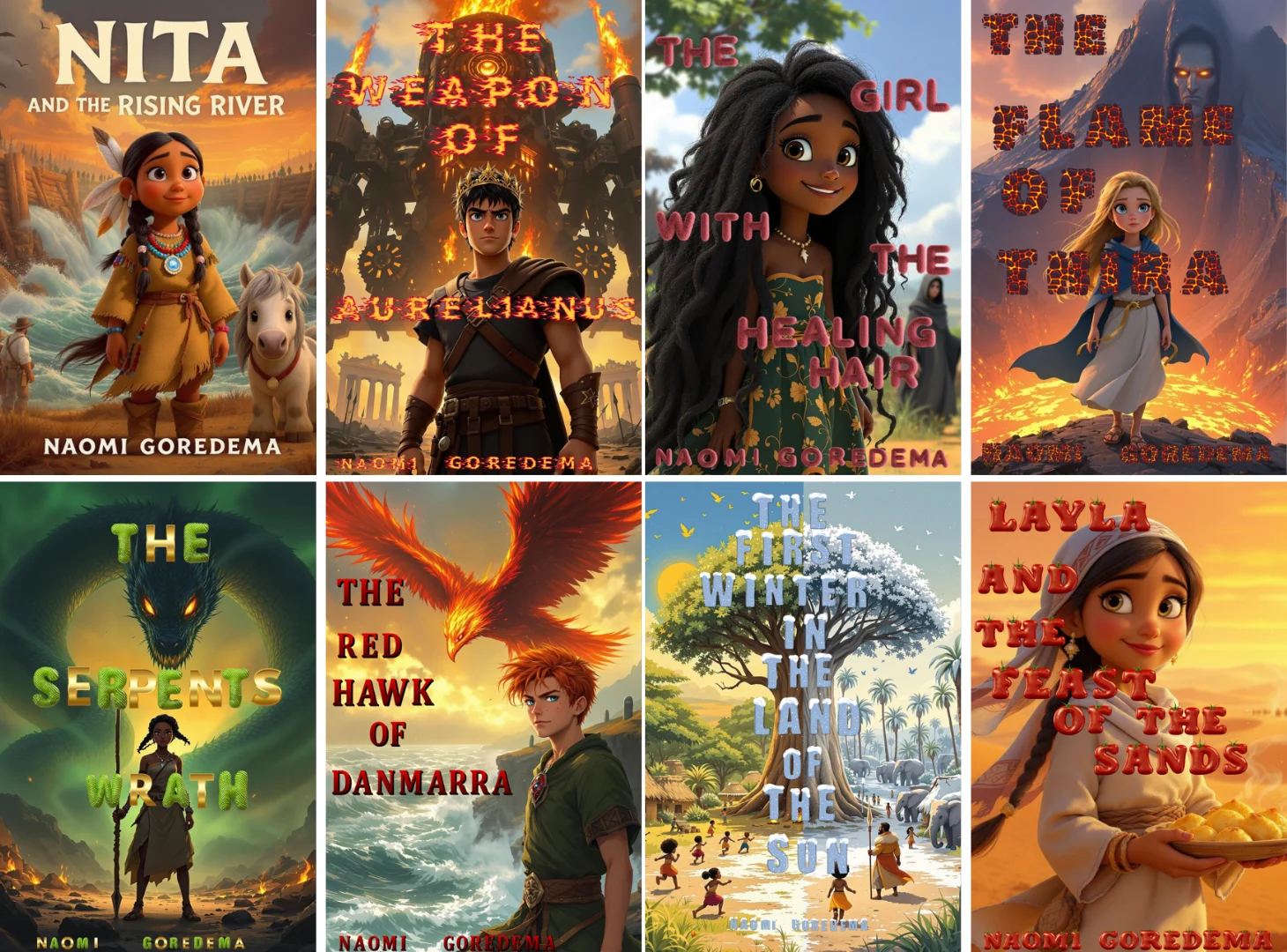 On Lumi
Lumi is young, so this is founder and forum talk, not a review corpus. G2 lists it with no reviews yet. The praise is real and it is about speed.
"You stopped making parents configure a book. Let them talk like they talk to their kid. The real hook is bedtime sorted in 10 minutes."
"Dashboards full of dropdowns for genre, era, and art style failed because parents and educators found it overwhelming."
That is the real Lumi pitch, said plainly. If "bedtime sorted in 10 minutes" is your job, Lumi nailed it. The thin review base just means you would be an early creator if you sign up.
On NeolemonOur proof is finished work, not tool reviews.
Credit where it is due
We will go first. These are things Lumi does better than us. If one of them is what your project needs, Lumi is the right tool and we mean it.
Roughly ten minutes from a sentence to a full illustrated story. Nothing on the market is better at "make me a whole story right now."
For casual, gift, and classroom one-off stories, the price ladder is generous and the free tier alone makes a handful of full stories.
A story bible, chapters, full text. If your job is to invent the story, not just draw it, Lumi does that and we do not.
Page-flip animations, theme modes, multi-voice narration, a built-in reader. We ship assets, not an in-app reader.
Upload a photo, pick a style, and your kid becomes the protagonist. A sharp, emotional gift product.
No manuscript, no character bible, no style guide needed. You ramble, Lumi shapes it. If you are starting cold, start here.
Take Lumi seriously and build something good. If you later hit the wall most book-series authors do, on control and consistency, you know where we are.
Our turn, same rules
Cartoon-only, on purpose. Built around the one job that breaks a real book series.
Not a feature bolted onto a story flow. The whole tool exists to hold one character steady across every page.
Targeted editors fix the one thing that broke, pose, expression, outfit, without rebuilding the page you liked.
You wrote the story and do not want it rewritten. You want it drawn, scene by scene, exactly as planned.
4 credits an image, full stop. You can budget a whole book before you start, not discover the cost mid-project.
Upscaling, Reframe, Storyboard View, PDF export, AI Canvas. A beautiful in-app reader is not a print interior.
Reuse one hero across many books, by hand or through the Segmind V3 API. Lumi offers no API.
Any image becomes a print-ready coloring page in one click, a high-volume self-publishing category.
Three straight years sharpened on one job. Lumi spans more genres; we go deep on consistent cartoon storytelling.
Cartoon-only, no native print, three-plus characters still iterate. We say so up front. You would rather hear it now.
Route yourself
Choose LumiChoose NeolemonUse bothThe switch
Decided your next project needs the heavier production control? Here is the cleanest path, start to finish.
20 credits, about 5 generations. Pick the hero that matters most to your next project.
Paste a rough description, or upload the portrait Lumi made you, and let it build a structured prompt.
Get one full-body front view you love and save it. Every scene branches from this single reference.
Action for poses, Expression for emotion, Outfit for clothing. Resist asking one prompt to do five things.
Story Scene Pro takes your anchor, a second character, and a background reference into one directed scene.
Drag the scene assets in, add text overlays, and export the laid-out pages.
Re-check trim size, bleed, 300 DPI, and KDP cover specs in your layout tool before you submit.
Upload to KDP, Lulu, or IngramSpark, and disclose AI images, which KDP requires regardless of the tool.
Most creators coming from a generate-the-whole-story flow are surprised by step 4. It feels like more steps. The payoff is that page 23 does not break the book.
No half-truths
LumiNeolemonTwo things are true for both tools, and easier to say now than to discover in month two: commercial-use rights are not the same as copyright ownership, and Amazon KDP requires you to disclose AI-generated images. We would rather lose a buyer to honesty than win one with a half-truth.
Questions
For creators producing illustrated children's books, comics, social storytelling, or brand mascots, yes, directly. Both tools generate AI illustrations for stories. Lumi's focus is generating a complete illustrated story experience from a conversation. Neolemon's focus is keeping one character consistent across many scenes, with editors that give you scene-by-scene control a story generator does not expose.
Neolemon, on balance. Our editing surface, Action, Expression, Outfit, Perspective, Multi Character, and Story Scene Pro, was built for the same-character-across-24-to-32-pages job that picture books require. Lumi produces illustrated stories quickly, but its public site does not document KDP-print export or per-page production control at the same depth.
When you want a personalized story fast, you have an idea rather than a manuscript, you want the AI to write the words, or you want narration, a built-in reader, and a shareable in-app experience. For parents, gift-makers, hobbyists, classroom one-offs, and first-time creators, that all-in-one flow is hard to beat.
Neolemon's Creator Plan is $29 a month for 600 credits, about 150 Character Turbo generations at 4 credits each. Lumi's paid plans at lumi8.dev are $9, $19, and $39 a month with 1,500, 4,000, and 8,000 credits, priced by stories rather than per-generation. Neolemon costs more than Lumi's Starter but gives you predictable per-image cost and the full editing suite.
Yes, this is the core product. Generate an anchor character with Character Turbo, then use Action, Expression, Outfit, Perspective, and Background editors to vary scenes while keeping the character on-model. Every scene conditions on the one anchor reference.
No. Neolemon handles the visuals, characters, scenes, and layout. You bring the story, or plan it with our free Cartoon Story Script Writer GPT. If you specifically want a tool that generates the text alongside the illustrations, Lumi may suit you better.
Two ways. Multi Character composes two characters in one scene, with V2 currently square-aspect only. Story Scene Pro takes one to three character references plus a background reference for directed composition. We are honest that three or more characters in one frame still pushes current AI limits and may require iteration.
Both tools' paid plans permit commercial use of generated images. Lumi's founder has stated on Reddit that users retain rights to their outputs, and Neolemon's paid plans include commercial-use rights. Neither permission is the same as a registered copyright, the law for AI outputs is still evolving, and Amazon KDP requires AI disclosure regardless of which tool made the image.
No on both. If synced multi-voice narration and an in-app page-flip reader are must-haves, Lumi wins those outright and we would point you to it. Neolemon ships finished illustration assets, a Storyboard View, and PDF export instead.
That is a different product. Lumi Story AI at lumistory.ai is a K-12 literacy platform sold to school districts on tailored, quote-based pricing. If you are a school or district leader, that may be your answer. This page compares Neolemon to the creator tool at lumi8.dev.
Yes. Neolemon gives 20 free credits, no card required, about 5 Character Turbo generations, enough to try the workflow before committing. Lumi gives 300 credits on its free tier, enough for roughly 3 to 4 stories.
Yes, both are month-to-month creator subscriptions. Neolemon's Creator Plan can be cancelled from your account at any time.
When the book is finished, what was the hard part? If it was inventing the story and shipping one fast, you wanted Lumi. If it was keeping your hero on-model across every page, you wanted Neolemon.
Run one character through the editors and watch the face stay put. 20 free credits, no card.
If Lumi is the right tool for your project, use it. If consistency is what you are after, that is what we built. Whichever you choose, ship the book.